Return to menu
FIRST LIGHT
Musée des arts et métiers, Paris
4 November 2015 – 31 January 2016
Presented as part of the International Year of Light
in partnership with the Observatory of Paris
This project is supported by the Victorian Government through Creative Victoria and assisted by the Australian Government
through the Australia Council for the Arts, its arts funding and advisory body.

First Light is an artistic journey into the origins of the capture of light. This project is the culmination of one year as artist in residence at the Musée des arts et métiers, Paris, researching the light sciences collection and, most importantly, the work of the French physicist, Léon Foucault.
The exhibition centres on three of Foucault's experiments in light
– the earliest surviving photograph of the Sun, made with Hippolyte Fizeau (1845)
– the perfection of the mirrored glass telescope lens (1860)
– and the conception of the first precise laboratory measure of the speed of light (1862).
  
These discoveries inspired a series of contemporary artworks that seek to render visible the hidden face of light. Melding art and science, many of these works have been realised in collaboration with scientists and historians in the domains of photonics (the Extreme Light Group), astrophysics and astronomical photography. The result, three installations displayed in the ancient church of Saint-Martin-des-Champs at the Musée des art et métiers.
Photo credits (left-right): Daguerreotype of the Sun, Hippolyte Fizeau & Léon Foucault, 1845. Musée des arts et métiers-Cnam. Photo: Pascal Faligot. Léon Foucault, 20 cm Telescope, 1860. Observatory of Paris. Photo : S. Pelly. Turning mirror, Léon Foucault, 1862. Observatory of Paris. Photo J.-M. Kollar.
First Light & β PERSEI exhibition catalogue

Media release (PDF)
1/UNDER AN EPHEMERAL SUN
A series of paintings, videos and archival objects based on the forgotten history of the first photograph of the Sun and the oldest surviving solar daguerreotype, taken in 1845 by Fizeau and Foucault which is in permanent storage at the Musée des arts et métiers archives. Installation situated around the Pendulum of Léon Foucault in the Musée chapel.

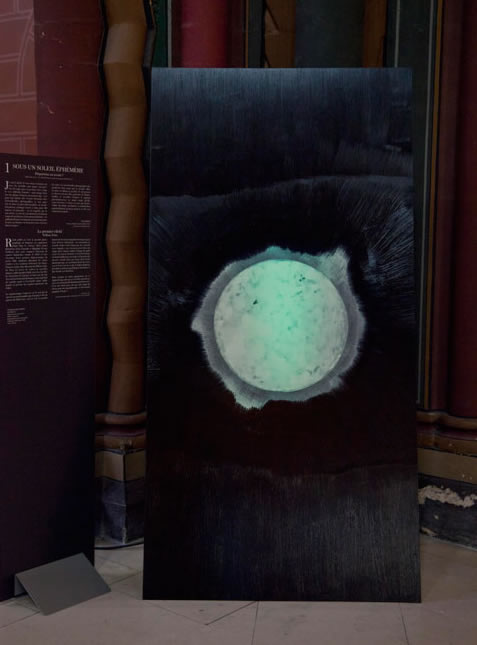 
Left & above: Disappearance or the future, 2015. Oil paint and photoluminescent pigment on plexiglass, backlit by UV LED. Right: The gravity of light, 2015. Acrylic paint and photoluminescent pigment on optical mirror and (also below) daguereotypes of the Sun, the solar spectrum and scenes of the Observatory of Parisrealised by Dominique Genty.


2/ ECLIPSE [...] DIAPHANE
A short film shot on the Faroe Islands during the total solar eclipse 20 March 2015 with the collaboration of the local Faroes community and contemporary composer Sunleif Rassmussen. Video subtitles drawn from Léon Foucault's essay on the 1860 total solar eclipse in Spain. Also displayed is Foucault's first reflecting mirror telescope (1860, Observatory of Paris.), which travelled to Spain to observe this eclipse.

Extract from Eclipse [...] diaphane, 2015
3/ BEYOND THE SPEED OF LIGHT
A dual video installation that exposes the scientific imagination of Léon Foucault and his conception of the first precise laboratory measure of the speed of light in 1862, alongside the original experimental instruments from the Observatory of Paris. The making of Light in Flight entailed a year-long collaboration with physicists Geneviève Gariepy and Daniele Faccio from the Extreme Light Group at Heriot Watt University, Edinburgh.

Beyond the speed of light, 2015. Original experimental instruments from the Observatory of Paris and dual video installation. Installation view, tower of the chapel.

In The owl of Minerva and I, Foucault narrates in voiceover his conception of the 1862 speed of light experiment, citing Hegel and his metaphor of Minerva's owl, which only takes flight at the dusk, to explain how he came to measure light, knowing that we only see it in the aftermath of its flight.
Extract fromThe owl of Minerva and I, 2015
 
Light in Flight, captures for the first time light as it travels in air, in a reconstruction of Foucault's original experiment. This film was realised with ultra-fast camera technology invented by physicists from the Extreme Light Group at Heriot Watt University, Edinburgh.
 
Extract from Light in Flight, 2015
Finally, The Metre, a solid bronze sculpture fashioned from a piece of rotting timber and formed into a model of the prototype metre measure of 1799, a copy of which is on display in the Musée des arts et métiers.Today, the metre is measured in reference the numeric value of the speed of light in a vacuum to exactly 299, 792,458 metres per second.
 
The Metre, 2011. Solid bronze, 100 x 2 x 1.5 cm.
|