| Object
relations: I want to break free
By Kyla McFarlane
Download
catalogue (344k)
In the struggle of our daily existence, the home can be our
comfort or our cage. In Lily Hibberd’s recent series
of paintings I want to break free, our domestic surroundings
are figured as a precarious, even dangerous realm. Hibberd’s
subjects tussle with the trappings of their domestic environment
as if their life depends on it and, in some cases, the effect
is catastrophic.

Behind closed doors,
2006, Pegasus print
Hibberd is an artist who has always held a fascination for
film. And, in many ways, these small dramatic scenes allude
to filmic genres. The shower scene in Psycho, the
domestic obsessions in American Beauty, a half-remembered
scene from Ghostbusters and a myriad of teen slasher
films sit somewhere in the latent, collective memory of these
works. And Hibberd prompts us to think cinematically, providing
us with an establishing shot of a house photographed at night.
Here, the orange glow emitting from its windows in a dark,
empty street scattered with dead leaves suggests the home
as a sinister, rather than comforting, realm. However, these
paintings are not simply scenes from an unmade film of suburban
lives. Solid skeins of paint leak across the picture plane
from the edge of each large canvas, acting as a kind of theatrical
curtain that simultaneously reveals and entraps each scene.
This rupturing of painted space reminds us that these scenes
exist in the field of representation and are therefore subject
to its limitations and tropes. Hibberd’s subjects are
trapped, not only in the four walls of the home, but also
by the bounds of their representational framework. The paintings
are also the final link in a complex representational chain
developed by the artist in the course of making the work.
Beginning with written fragments, Hibberd then stages each
scene photographically before moving to the final painted
work. This merging of mediums has an uncanny effect, as each
painting retains residues of this process, holding fragments
of narrative together with the simulacral effect of the photograph.
The result is a tangle of references from representation’s
vast domain, as traces of each medium are merged with urban
mythologies and the singularity of any one of our personal
histories blends with the collective unconscious of our cultural
realm.


Security screen
& Slip up, oil & pencil on linen, 2006
Although the paintings in I want to break free convey
a sense of drama and intrigue, their single-shot partiality
refuses us the pleasure of the dramatic denouement. The ‘knot’
of narrative suspense is not unravelled, and the luxury of
cause and effect is not revealed by the paintings themselves.
The subjects, whilst depicted in a climatic moment, are caught
in cyclical narratives of repetition and compulsion, from
which they seem unable to break free. Take, for example, the
habitual wrestle with the doona cover in Clean sheets,
or the woman standing at the screen door to watch the sunset
in Security screen. Both these moments emerge from
the smallest of recurring interior narratives, borne from
frustration and anxiety, or boredom, or shame. Entangled in
the bedclothes, or unable to move beyond the back door, Hibberd’s
painted subjects provoke in us an existential insight: perhaps
this is as good as life gets. These are small stories of discomfort
and claustrophobia, but their re-presentation as painted scenes
throws the poignancy and pathos of each scenario into sharp
relief.
Light pervades these paintings, but they are infused with
a dark humour. In Garden variety, Hibberd depicts
a suburban Laocoon struggling not with a serpent, but his
garden hose. The backyard scenario is at once courageous and
absurd, as Hibberd replaces mythological heroics with a situation
that is ‘garden variety’ in its ordinariness -
the struggle against an overgrown garden and a wayward, writhing
hose. If Laocoon and his sons exemplified a dignified suffering,
Hibberd’s backyard Laocoon struggles against the indignity
of the banal. It’s a battle played out in each of these
paintings, and one that is often lost to the domestic object.
In Super cycle, a woman is alarmingly impaled on
a poorly-positioned knife in the dishwasher, whilst Slip
up features a man facing the ignominy of self-injury
in the bathroom, his head cracked on the toilet seat after
slipping in the shower stall. For Hibberd, the dangers of
the ordinary clearly lurk in every corner of the house.
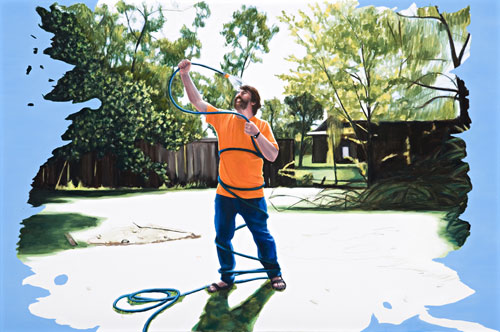
Garden variety,
2006, oil & pencil on linen
A suite of smaller paintings in the series continues to unravel
the psychological intensity of these object relations. For
instance, an isolated yellow rubber glove, set in a pink colour
field, is attended by the text ‘every time I think of
you I cry’… In these works, the most insignificant
of household objects become containers of meaning –
receptacles for anxieties, desires and imaginings. Against
the larger dramatic paintings, these objects appear uncanny
and their partial, often despondent, texts allude to universal
human sentiments and the torpor of the daily domestic grind
in the absence of more meaningful pursuits. And yet the works
in I want to break free refuse any such assurances
of reality, wrestling as they do in an irresolute dialogue
between fiction and documentary, illusion and reality. Deep
in the cycle of endless repeat, however, Hibberd reveals a
modicum of hope, where in one image, beneath a glowing doorbell,
the words ‘for the last time’ offer the small
possibility that maybe, just maybe, the cycle of existential
entrapment might be broken.

Domestic bliss,
2006, oil & pencil on linen
Dr Kyla McFarlane is Assistant Curator of Exhibitions
at Monash University Museum of Art, Clayton Victoria |
